
Safety & Compliance
Review safe handling, power limits, and the pending compliance status of the ALPON X4 edge computer before installation or deployment.
Operate the ALPON X4 safely and within spec
Handling, power, thermal, antenna, port, and regulatory rules for the ALPON X4 industrial edge IoT computer. Review every section before powering, mounting, or deploying the device in the field. Built on Raspberry Pi.
The ALPON X4 is a fanless industrial edge IoT computer
rated for −20 to +60 °C ambient and IP40,
powered by one input at a time: the DC terminal block,
USB-C PD at 15 V / 1.8 A (27 W), or optional PoE+ on ETH/G.
DC is rated 9–30 V; use 12–30 V for full peripheral functionality.
PoE+ delivers up to 25 W, below the 27 W system peak,
so reduce peripheral load or use DC/USB-C PD for peak workloads.
Compliance work is pending; certificates have not been issued.
Never connect Ethernet or PoE to the GPIO Add-on port; it can
cause permanent hardware damage. Built on Raspberry Pi.
The GPIO Add-on port uses an RJ45 socket but exposes 3.3 V GPIO, SPI, UART, and I²C signals, plus a 5 V at 1 A output rail for attached modules. Connecting an Ethernet cable or a PoE source will cause permanent hardware damage. Use the port only with Sixfab GPIO add-on modules.
Safety reference at a glance
Key environmental and electrical limits for safe operation. See the ALPON X4 specifications for the complete ratings.
ETH/G onlyGeneral handling
Universal rules that apply to every installation, regardless of power source or mounting orientation.
The aluminum enclosure acts as a heatsink and may reach high temperatures during sustained workloads. Avoid touching the top cooling surface during extended operation or immediately after shutdown.
The device is rated IP40. Keep it away from liquids, condensation, and flammable materials. Direct outdoor exposure requires a separate protective enclosure.
Apply standard ESD precautions (wrist strap, grounded mat) when handling the device with the enclosure open or working near exposed connector pins.
The ALPON X4 contains no user-serviceable parts. Opening the enclosure voids the warranty. Contact Sixfab support for any internal repair or modification.
Do not insert metal or conductive objects into ports, vents, or connectors. Avoid impact damage to the aluminum housing and antenna connectors.
Power safety
Choose the DC terminal block, USB-C PD, or optional PoE+ on PoE-variant SKUs. Use only one input at a time; do not rely on automatic source switching or failover.
How do I power the ALPON X4 safely?
ETH/G only. PoE-variant SKUs only.
Power source selection
Use only one power input at a time. Disconnect the existing source before connecting another; do not use multiple connected sources as a redundancy or failover arrangement.
Typical consumption is 7–14 W with a 27 W system peak. Optional PoE+ delivers up to 25 W and cannot cover that simultaneous peak. Reduce peripheral load or use a supported DC/USB-C PD supply for peak workloads. Do not infer any particular overload or automatic load-shedding behavior.
PoE+ is available only on variants that include the built-in PoE module. The module cannot be added in the field. Use a PoE+ (IEEE 802.3at) Class 4 injector or switch supplying 37 to 57 V; legacy PoE (802.3af) cannot deliver enough power for the ALPON X4.
ETH/G carries Gigabit Ethernet data and, on PoE variants, PoE+ power input. The 100 Mbps ETH port is data-only. Neither port supplies PoE power to another device.
Keep terminal-block input within the rated 9–30 V DC range. Below 12 V, peripheral functionality is restricted; use 12–30 V at the device for full functionality. Operation outside the rated range is unsupported and may damage the device.
DC terminal block wiring
The DC terminal block uses a 3-pin layout with marked polarity. Wire it exactly as shown to avoid tripping the reverse-polarity protection.
For long DC cable runs, size conductors for the load and voltage drop. A 24 V supply can provide more voltage-drop margin than a 12 V supply while remaining within the rating. Verify that the voltage at the device remains 12–30 V under load for full peripheral functionality.
USB-C PD requirements
Use the included USB-C PD adapter or a compatible source providing the documented 15 V at 1.8 A (27 W) profile.
Standard 5 V USB-C chargers and PC USB ports are not supported for normal operation. The USB-C port requires a USB-PD-capable source negotiating 15 V.
The USB-C port is sink-only for power. Use USB Type-A for normal data peripherals. Recovery or flashing access must follow model-specific Sixfab instructions; do not infer a recovery procedure from the connector shape.
Non-compliant USB-C cables can drop voltage under sustained load even with a capable adapter. If consumption approaches 27 W, swap cables for ones rated above the minimum.
Thermal safety & mounting
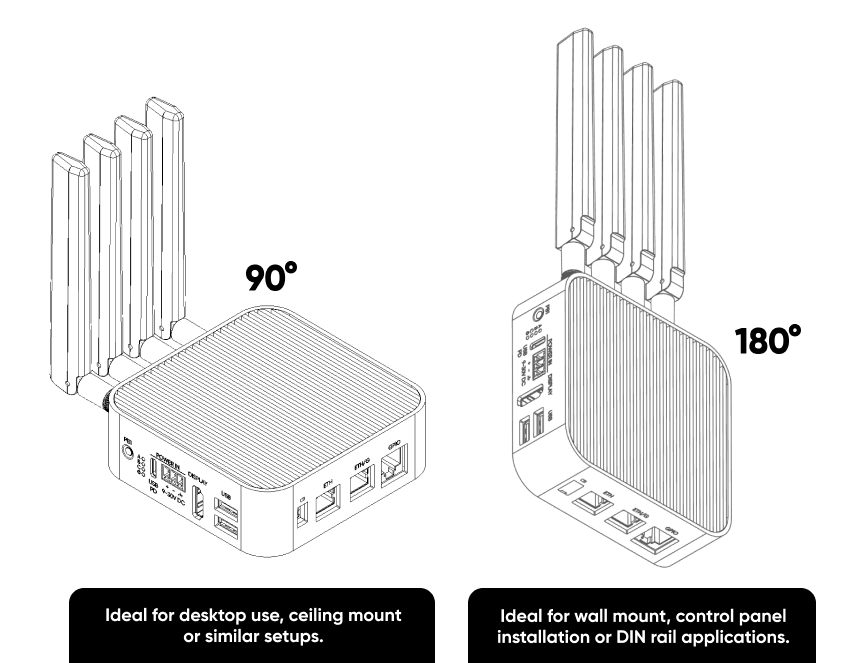
The fanless aluminum top is the primary heatsink for the Raspberry Pi CM4. Mounting orientation directly affects sustained throughput.
Recommended mounting orientations
Environmental clearances
Keep the device away from direct heat sources (ovens, motors, boilers) and steam. Radiant heat reduces ambient headroom against the +60 °C operating limit.
Keep airflow around the cooling surface unobstructed and verify cabinet ventilation against the combined heat load. Consult Power & Mounting and Sixfab for verified mechanical clearance guidance; no numeric certified minimum is established here.
Two 4 mm mounting holes on the rear of the enclosure support DIN rail or wall mounting with the appropriate accessories. Ensure mounting hardware does not contact the cooling surface.
Antenna & RF safety
Four antenna ports serve LTE Main, LTE Diversity, Wi-Fi/Bluetooth, and GNSS/GPS. Wi-Fi uses RP-SMA; LTE and GNSS use SMA. Match each antenna to the labeled port and confirm replacement connector compatibility before ordering.
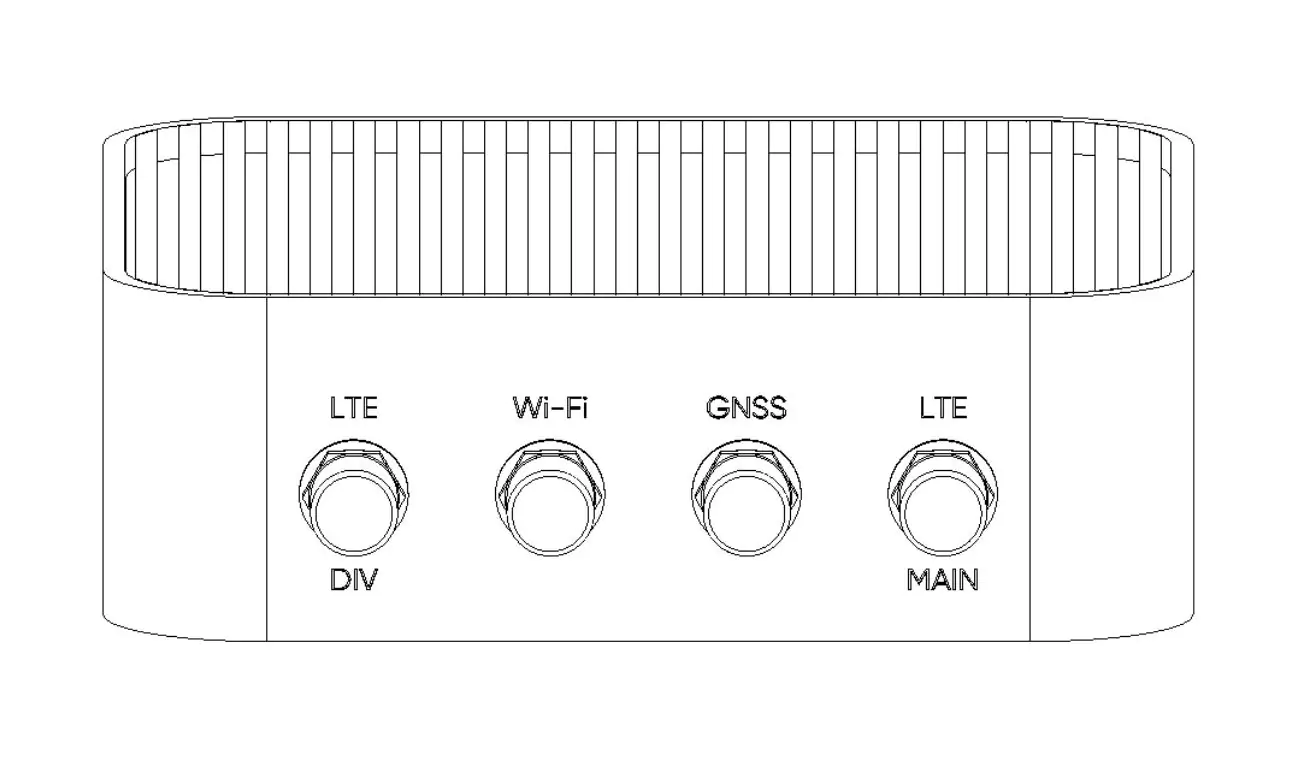
Antenna specification
The Wi-Fi port uses RP-SMA; GNSS and LTE use SMA. Confirm the mating connector against the supplied antenna or with Sixfab before ordering. Do not force an incompatible connector or assume SMA and RP-SMA are interchangeable.
Installation & handling
Never install, remove, or service antennas while the device is powered on. Disconnect every power source first to prevent electric shock and RF transmitter damage.
Hand-tighten antenna connectors without forcing or over-tightening them. Use a torque tool only with connector-specific limits confirmed by Sixfab or the antenna manufacturer.
Inspect connectors for corrosion, debris, or damage before each reattachment. Replace compromised connectors rather than forcing a fit.
For outdoor or harsh environments, use the optional 3-meter cabled IP67 combination antenna with surface mount instead of the bundled stub antennas.
Placement & signal quality
Do not swap antennas between ports. LTE, Wi-Fi, and GNSS ports are tuned for different frequency bands; mismatched antennas degrade link quality and may overload the RF front-end.
Keep antennas clear of metal surfaces, reinforced concrete, and other sources of electromagnetic interference such as microwave ovens, cordless phones, and large motors.
The GNSS antenna must be placed in an open area with the top facing the sky. Obstructed or ground-level placement degrades time-to-first-fix and position accuracy.
Port & connector safety
Several ALPON X4 ports share physical form factors with unrelated standards. Read the port-specific rules before cabling.
GPIO Add-on port: not an Ethernet port
The GPIO Add-on port uses an RJ45 jack but exposes 3.3 V GPIO, SPI, UART, and I²C signals, plus a 5 V at 1 A output rail for attached modules. It is not wired for Ethernet or PoE.
Connecting an Ethernet cable or a PoE source to the GPIO Add-on port can permanently damage the device. The GPIO lines run at 3.3 V logic; PoE voltage (up to 57 V) destroys the signal pins and the level shifter. Use the GPIO Add-on port only with Sixfab GPIO add-on modules.
Port function reference
USB 2.0 port output limit
The two USB 2.0 host ports share a combined 5 V at 1 A total output budget. Plan accordingly when attaching peripherals.
When attaching high-draw USB peripherals (SSDs, cellular dongles, external hubs), budget current across both ports together, not per port.
For USB peripherals that exceed the on-device budget, use a powered USB hub with its own external supply.
Watchdog & Boot/Burn DIP switches
Two DIP switches control firmware-level behavior: Watchdog enable/disable and Boot/Burn mode.
Watchdog DIP. When enabled (SW1 OFF), the host must supply the documented watchdog heartbeat or the device resets. Assign one heartbeat owner: the system daemon or an application configured to replace it, never both. Disable the watchdog (SW1 ON) for controlled servicing only, with power disconnected before changing the switch.
Boot/Burn DIP. SW2 OFF is normal Boot mode; SW2 ON is Burn mode. Change it only with all power disconnected and only as directed by the supported recovery procedure. Contact Sixfab before flashing if the model-specific host connection and recovery image are not confirmed.
Fully disconnect every power source before changing the Boot/Burn DIP position. Toggling under power leaves the bootloader in an undefined state.
Regulatory compliance & certifications
ALPON X4 compliance work is in progress. The items below are targets, not issued certificates or permission to deploy in a particular market. Confirm current evidence for the exact model and destination with Sixfab before procurement or deployment.
No certificate has been issued yet. This target list is not final compliance evidence. Request current model-specific declarations, authorization records, or certificates from Sixfab when available. Regulatory conformity, environmental obligations, cellular-industry certification, and individual carrier approvals are different requirements; none should be inferred from another.
Compliance targets — not issued approvals
CE, UKCA, FCC, IC/ISED, RCM, and ICASA relate to regional regulatory requirements. RoHS, WEEE, REACH, and RED are legislation or compliance obligations, not interchangeable product certificates. GCF and PTCRB are cellular-industry certification programs, not approvals from named carriers. The list does not establish carrier acceptance.
Applicable standards and conformity evidence
The final standards, test scope, model variants, and authorization identifiers must be confirmed in the issued compliance documentation. This guide does not establish test completion, accredited-laboratory status, or a pass result. Request the current evidence from Sixfab rather than treating a planned standard as proof of compliance.
Need the current compliance status for a procurement or deployment decision? Provide the device model, serial number, destination market, and required evidence when contacting Sixfab.
Request status updateRegional operating conditions
Certification status is pending. Obtain the final model-specific regulatory notices and operating conditions from Sixfab when issued; this page does not substitute for those documents or establish authorization to operate.
Do not modify the enclosure, radio hardware, or antennas without guidance from Sixfab. The configuration covered by any future declaration or authorization must be checked in that document; do not assume modifications remain covered.
Environmental & end-of-life
RoHS, WEEE, and REACH are compliance targets, not confirmed approvals here. Follow local electronics and battery disposal requirements at end-of-life.
Do not dispose of the device in unsorted household waste. Return it through an authorized WEEE collection point, a local electronics recycler, or back to Sixfab for responsible processing.
The ALPON X4 contains a CR1220 coin-cell battery for the real-time clock. The battery is accessible only through authorized service and must be disposed of separately at end-of-life.
Before disposal or return, erase sensitive data from the eMMC and any connected storage. Retain the original packaging for return shipping.
Warranty
The ALPON X4 ships with a 2-year limited warranty against manufacturing defects. The warranty does not cover damage caused by:
- Power input outside the rated envelope (below 9 V, above 30 V, or non-compliant PoE injectors).
- Connecting Ethernet or PoE cables to the GPIO Add-on port.
- Unauthorized modification of firmware, enclosure, or internal modules.
- Operation outside the rated environmental envelope (−20 to +60 °C, 95% non-condensing humidity, IP40).
- Physical damage from impact, liquid ingress, or electrostatic discharge.
- Failure to follow the safety and usage instructions in this document.
Submit warranty claims with the device serial number, purchase date, and a description of the fault.
Contact SixfabUpdated 1 day ago